
Why 90% of In-House AI Video Tests Fail Before Reaching an Ad Account
Last year, marketing heads rushed to buy every enterprise generative video seat they could expense. The logic sounded bulletproof: cut the $45,000 studio retainer, fire up a text-to-video dashboard, and start publishing 30 high-converting creatives a week.
Fast forward several months, and most of those seats are gathering dust.
The reality hits the moment a team tries to produce something beyond a three-second abstract drone shot. A founder holds a bottle whose label typography shifts between cuts. An actor's facial symmetry warps mid-sentence. A brand’s signature teal color palette grades into muddy cyan by scene three. What looked revolutionary in an isolated demo reel collapsed into a costly exercise in prompt roulette.
"Gartner recently projected that through 2026, over 60% of enterprise generative AI deployments will fall short of expected business value—primarily due to workflow friction, integration gaps, and uncontrolled output variance."
The friction isn't the underlying models. The friction is the mistaken belief that a raw prompt can replace a post-production pipeline.
The Reality Gap: Raw Generations vs. Commercial Assets
When a creative director evaluates a finished commercial, they evaluate consistency, visual hierarchy, and pacing. Raw generative tools don't understand any of those concepts natively—they calculate probabilistic pixel arrangements.
- Brand Geometry & Typography: An e-commerce brand spends months dialing in packaging Pantone codes and custom font kerning. Generative diffusion models natively hallucinate text and blend background pixels directly into label boundaries.
- Temporal Consistency: If an ad features a spokesperson explaining a value proposition, the character's lighting, wardrobe, and vocal cadence must remain steady across cuts. Prompting the same actor twice in a text-to-video tool yields two entirely different people.
- The "Uncanny Valley" Drop-Off: In consumer testing conducted across major short-form paid channels (Meta, TikTok), minor physical distortions—such as erratic finger motion or unsynced lip mechanics—consistently suppress click-through rates by up to 25–40%. Viewers subconsciously flag the content as deceptive or low-budget before the value proposition is delivered.
The Hybrid Pipeline: How Production-Grade Teams Actually Use AI
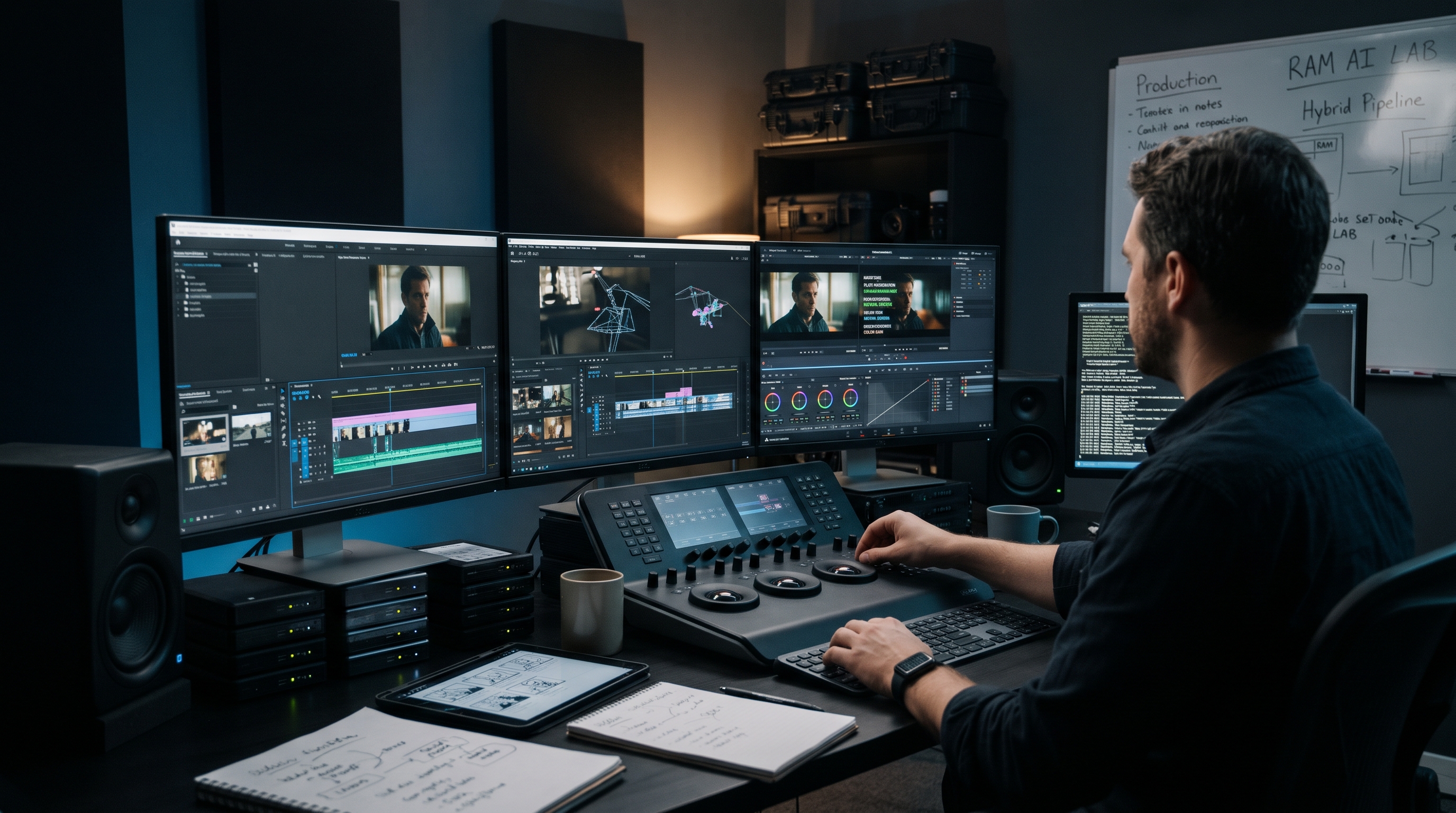
At RAM AI Lab, we stopped viewing generative models as "automated directors" long ago. We treat them as raw render engines. The difference between a throwaway synthetic clip and a scalable asset lies in a structured hybrid pipeline—where machine velocity is bounded by rigorous studio control.
1. Deterministic Seeding Over Random Prompts
Instead of feeding open-ended paragraphs into a prompt box, commercial pipelines use fixed seeds, camera path constraints, and multi-control adapters (like depth maps and pose guides). This locks lighting direction, depth of field, and camera parallax before rendering a single frame.
2. Selective Inpainting & Plate Preservation
Real-world physical assets—such as bottles, packaging, logos, and UI screens—should rarely be generated from scratch by an AI video model. They are shot or isolated as high-resolution digital plates, then composite-blended into AI-synthesized background environments using pixel-accurate masking and match-moving. The brand asset remains 100% authentic; the production cost around it drops by 70%.
3. Human Sound Design & Micro-Pacing
Viewers forgive imperfect visuals long before they forgive flat sound. A computer-generated scene paired with synthetic, unmixed voiceover screams "automated spam." Layering custom foley, spatial sound design, and studio-grade voice mastering restores sensory weight and keeps viewer retention past the critical 3-second hook.
Production Economics: Studio Shoot vs. Prompting vs. Hybrid Execution
A High-Performance Asset Requires a Whole Ecosystem
Creative cannot win in isolation. A high-production commercial asset deployed on top of a slow website, a fragmented landing page, or an unindexed domain will fail to convert.
This is why modern digital agencies must move past siloed definitions. Generating an engaging video is step one; ensuring that the landing experience loads in under 1.8 seconds, that search queries capture post-view brand interest, and that user journeys are instrumented for conversion tracking is what turns views into revenue.
Generative AI hasn't killed craft. It has raised the bar. The brands pulling ahead today aren't the ones hoping software will run their marketing on autopilot; they are the ones combining cutting-edge tools with classic execution discipline to move ten times faster than their competitors.